

Arum maculatum (Lords-and-Ladies)
Arum maculatum (Lords-and-Ladies)
Lords & Ladies
Couldn't load pickup availability
Sustainably Grown Organic Arum maculatum
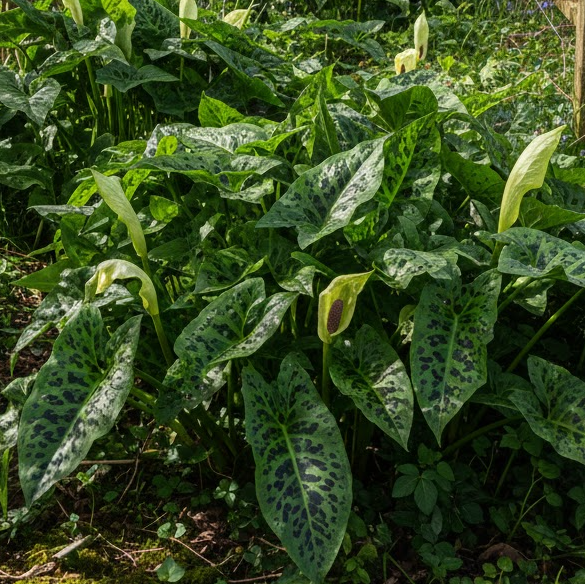
Arum maculatum (Lords-and-Ladies, Cuckoo Pint) is a distinctive woodland perennial renowned for its curious hooded flowers and glossy arrow-shaped foliage that brings intrigue to shaded gardens. This native British wildflower combines architectural interest with fascinating wildlife interactions, providing early spring interest followed by striking berries in autumn while thriving in challenging shade conditions where few other plants can compete.
Plant Features
Arum maculatum forms compact clumps reaching 30-45cm (12-18 inches) in height, with a spread of 20-30cm (8-12 inches). These fully hardy perennials excel in British gardens, thriving in partial to full shade positions with humus-rich, moisture-retentive soil. Their exceptional shade tolerance and native status make them ideal for sustainable woodland gardens and challenging shaded areas beneath trees and hedges.
Flowers
The curious pale green flowers appear in spring, comprising a distinctive hooded spathe that encloses a purple-brown spadix. This unusual structure measures approximately 15-20cm tall and serves as a sophisticated insect trap, temporarily holding small flies to ensure pollination before releasing them unharmed. The fascinating flowering mechanism provides early season interest and demonstrates remarkable evolutionary adaptation to woodland conditions.
Habit
Arum maculatum develops attractive rosettes of glossy, arrow-shaped leaves that emerge in late winter and provide fresh green foliage through spring and early summer. The leaves often display attractive dark purple spotting, adding decorative interest. Following flowering, the foliage dies back completely by midsummer, after which striking spikes of bright orange-red berries appear in autumn, providing a second season of visual interest and valuable food for birds.
Maintenance
Arum maculatum demonstrates excellent shade tolerance and thrives in the dry, root-filled conditions beneath trees where many plants struggle. The plant performs beautifully in woodland gardens, hedgerow bases and shaded borders, requiring virtually no intervention. Its native status ensures perfect adaptation to British conditions, with natural dormancy during summer reducing water requirements.
How to Care For Arum maculatum
Plant in a location with partial to full shade and humus-rich, moisture-retentive soil. This woodland plant appreciates leaf mould and performs well in the challenging conditions beneath deciduous trees. Space plants 20-30cm (8-12 inches) apart to allow natural spread through underground tubers.
Water during establishment, though mature plants demonstrate good drought tolerance during their summer dormancy. Apply leaf mould or well-rotted compost as a mulch in autumn to mimic natural woodland conditions and improve soil fertility.
Allow foliage to die back naturally in summer—do not remove until fully yellowed. The plant requires no deadheading as berries provide autumn interest and wildlife value. Clumps will gradually spread via underground tubers and self-seeding to create naturalistic colonies.
Is Arum maculatum Invasive?
Arum maculatum is not classified as invasive in the UK. As a native species, it integrates harmoniously into British ecosystems and spreads at a modest pace appropriate for woodland gardens. It can be controlled easily if necessary by removing young plants or restricting its spread.
Important Safety Note: All parts of Arum maculatum are toxic if ingested and can cause skin irritation in sensitive individuals. The attractive berries are particularly hazardous to children and pets. Plant in locations where berries will not tempt young children, and educate family members about the plant's toxicity.
This versatile native excels in woodland gardens, shaded borders beneath hedges, and naturalistic plantings. The early foliage provides ground coverage when spring bulbs are fading, whilst the autumn berries create a second season of interest. The unique pollination mechanism supports small fly populations, whilst berries provide food for birds including thrushes and blackbirds. Its ability to thrive in deep shade with dry soil and compete successfully with tree roots makes it an invaluable addition to sustainable garden designs seeking year-round interest in challenging locations. The native heritage ensures excellent performance whilst supporting local wildlife and maintaining authentic British woodland character.
Plant care guide
Plant care guide
How do you plant perennials?
Dig a hole slightly larger than the woodfibre pot or balled rootball size, but no deeper. If it is a plant that likes to stay on the drier side (such as lavender), make the hole slightly shallower than the root ball so the surface of the rootball sits proud of the ground and use organic matter around the plant to stop water pooling on the base of the plant.
Water the hole and if the woodfibre pot or rootball doesn't seem moist pre-soak the pot or hessian contained rootball until it is saturated (no more bubbles rise to the surface).
There is normally no need to add compost to the hole if you have an established garden with healthy plants already growing. If you have a newbuild property or poor growth to existing plans chances are that your whole flowerbed needs improving with organic matter.
Place the pot or rootball in the hole. You can remove the hessian sacking it came in, or just remove the staple/twine and open the top once it's in the ground so the plant is free. The roots will easily grow through and the hessian will decompose, as will the woodfibre pots. Back fill the surrounding area with the dug soil. Do not firm the soil down hard! Roots need air and water and hard compacted soil prevents them from getting both.
Once planted water the plant in well and then water again whenever the soil starts to dry out under the surface, being careful not to overwater.
Mulching with something like woodchips around the plant after watering will help the soil to retain the moisture in hot weather. The perennial's foliage will die off in the winter and the plant will regrow through the mulch in the spring!
When to plant perennials in the UK?
Perennial plants can be planted out in the garden or in pots from spring, through the summer, to autumn. During dry weather and especially during the summer much closer attention needs to be given to watering in the first year.
If planting in hot weather, cut the foliage and flowers back. Your new plant will not be taking up much water until established so may struggle if the leaves lose more water than the roots can absorb. For the strongest result do not allow to flower or at least to set seed in the first year.
Where to plant perennials?
Check the plant info at the bottom of the page for the best place to position your new plant. If it prefers sun and you plant it in a north facing flowerbed next to a wall don't expect it to thrive or flower.
Pay attention to the soil. if it is heavy clay, incorporate organic matter such as compost to the soil before planting your perennial, preferably to the whole flowerbed. This will improve the soil by buffering it's water and nutrient holding ability. It is preferable to not just plonk compost in the bottom of the hole as it will not improve the overall condition of the soil surrounding your new plant. Do not add a layer of gravel or grit to the bottom of the hole as this will merely cause the perched water table to be higher. It will not improve drainage.
How do you care for perennial plants?
Cut back untidy foliage in the spring (you can leave the clippings on the flower bed to allow the nutrients to recycle into the soil). Divide every 3 to 5 years as the centre dies out and replant your extra plants! Perennials come back every year. Some are longer living than others.
Should perennials be fertilised?
The vast majority of garden soils contain plenty of nutrients, but if your garden is in a newly built development there is a good chance a thin layer of topsoil has been added on top of infertile subsoil. if that is the case, compost, soil improver or well rotted manure can be spread on the flower bed and dug in, or alternatively for those short of time or energy, organic fertiliser such as our own special organic mix of bone meal, hoof and horn and vinaase that is an organic, sustainable alternative to the John Innes formula, can be sprinkled around the plant with some compost added to the planting hole.
Delivery £5 flat rate or FREE over £50 spend.
Delivery £5 flat rate or FREE over £50 spend.
I charge a flat rate of £5 for postage and packaging to all of Britain, including the Highlands and the Isle of Man, with free delivery for orders over £50. We are unable to send plants to Northern Ireland.
I use Royal Mail for our deliveries as they have the lowest carbon footprint per parcel delivered in the UK and actually tend to look after parcels rather than just chucking them over the nearest fence! This ensures that your plants will have the best care possible.
Please have a Safe Place set up if possible so your plants are not returned to the sorting office if no one is home to accept the delivery.
I try to dispatch plants twice a week and you will receive updates by text or email. In cases of extreme weather or if Royal Mail has a hiccup the delivery may be delayed but we'll keep you in the loop.
I'm unable to deliver to the Channel Islands or Northern Ireland.
The LAWNMOWER Guarantee
The LAWNMOWER Guarantee
Healthy plants & happy customers
Your plant will only be dispatched if I'm happy it is healthy. The nature of growing the plants in large troughs means that the root system will be trimmed before they are balled in hessian, and therefore, depending on the time of year, the top growth may also be trimmed to make sure the roots are able to supply the water and nutrients your new plant requires.
Pruning encourages new growth and this applies to roots as well so a pruned plant actually results in a stronger plant.
The LAWNMOWER guarantee.
If you're not happy with your plants for any reason, even if you've run them over with your lawnmower, just pop them in a box (the plants, not the mower!) and post them back to us within 1 year for a replacement or refund.
This does not affect your statutory rights.
For full details check out the Refunds and Returns Policy.
Sustainability
Sustainability
Eco-friendly business
Fed up with plants grown in plastic pots which are doused in herbicides and sprayed with synthetic chemicals by big nurseries who merrily burn through finite resources, fly plants in from abroad on jet planes, irresponsibly use peat and coir, kill any insect nearby with non-selective pesticides and generally only think of the bottom line?
So are we!
How we grow plants sustainably
Our plants are started in coldframes or inside our house, grown-on woodfibre pots or in reclaimed wooden troughs which are then carefully harvested and balled and burlapped (hessian wrap securing the rootball), before packing plastic free in a eco cardboard box from a certified B-corp carbon neutral supplier. Some plants are grown in 8cm woodfibre pots.
Sustainable and organic compost & fertiliser
Our Soil Association certified organic compost is bought in bulk without plastic bags from Dalefoot Compost, and consists of sheep wool, bracken and comfrey. This naturally feeds the plants for 12 months. If supplemental feeding is required we only use our own special blend of organic fertilisers (bone meal, hoof & horn and vinaase) which have been processed with solar energy.
Carbon Neutral business
The small amount of electricity we use is from renewable sources and we irrigate our plants with stored water we have harvested. Plus, we are using our house and land for more than one purpose, preventing further land use and utilising the sunk carbon cost of the building rather than creating more.
We have partnered with Carbon Neutral Britain to offset our emissions, and recognise that we are not in control of all parts of the supply chain so have fully offset scopes 1, 2 and 3 to take that in to account - so that's all emissions connected to our business, from the farts coming out of the back of the sheep, to the carbon dioxide from the delivery van outside your door.
We don't just offset and carry on, ALL the decisions we make work to reduce emissions - for instance we use Royal Mail to post our plants as they have by far the lowest carbon footprint per parcel delivered in the UK.
Arum maculatum